
 English



















































































































































































Starlink’s Cosmic Leap into India: Aadhaar-Powered KYC Lights the Way

A Stellar Fusion of Technology and Identity
In a bold move that blends cutting-edge satellite technology with India’s digital backbone, Elon Musk’s Starlink Satellite Communication Pvt Ltd has partnered with the Unique Identification Authority of India (UIDAI) to revolutionize internet access across the nation. On August 20, 2025, the Ministry of Electronics and IT announced that Starlink will harness Aadhaar-based e-KYC for customer verification, promising a seamless, secure, and paperless onboarding process. As Starlink gears up to beam high-speed internet to India’s remotest corners, this collaboration marks a historic synergy between global innovation and India’s trusted digital identity system. From Himalayan villages to coastal hamlets, the promise of connectivity is sparking excitement, but with regulatory hurdles and spectrum allocation still pending, the journey is just beginning. Here’s the full story for www.bharattone.com, weaving a tale of ambition, innovation, and digital destiny.
Starlink’s Mission to Connect India
Starlink, the brainchild of billionaire visionary Elon Musk, aims to blanket the globe with high-speed internet via a constellation of Low Earth Orbit (LEO) satellites. In India, where internet penetration lags in rural areas—only 37% of the population had broadband access in 2024—this mission is transformative. Starlink’s satellites, orbiting at 550 km, promise fiber-like speeds of 100–200 Mbps, dwarfing traditional providers in remote regions. Already operational in neighboring Nepal, Bangladesh, and Sri Lanka, Starlink secured a five-year license from India’s space regulator, IN-SPACe, in July 2025, and a Global Mobile Personal Communications by Satellite (GMPCS) authorization from the Department of Telecommunications (DoT). Yet, with spectrum allocation pending and security compliance under scrutiny, Starlink’s launch is slated for late 2025 or early 2026.
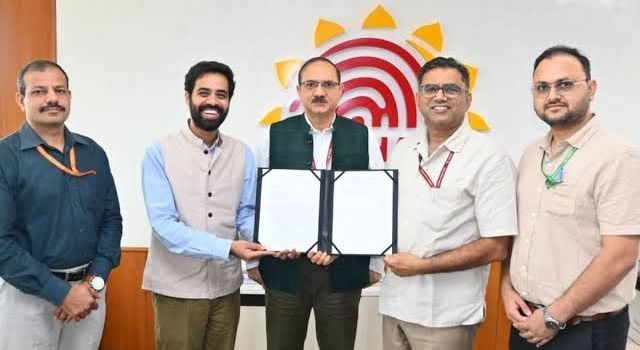
The game-changer? Starlink’s adoption of Aadhaar e-KYC, formalized in a ceremony attended by UIDAI CEO Bhuvnesh Kumar, Deputy Director General Manish Bhardwaj, and Starlink India Director Parnil Urdhwareshe. As a Sub-Authentication User Agency and Sub-eKYC User Agency, Starlink will use Aadhaar’s digital infrastructure to verify customers, ensuring compliance with Know Your Customer (KYC) norms while making onboarding “smooth, secure, and very easy,” per the Ministry’s statement.
Aadhaar: The Backbone of Digital India
Aadhaar, India’s 12-digit unique identity number, is the world’s largest biometric ID system, covering over 1.3 billion residents. Managed by UIDAI, it offers a paperless, verifiable identity through e-KYC, using biometrics (fingerprint, iris, or face scans) or OTP-based authentication via registered mobile numbers or emails. The process is voluntary, aligning with the Aadhaar Act, 2016, and ensures data security through encrypted XML files digitally signed by UIDAI. Service providers like Starlink can validate these files using UIDAI’s public key, ensuring authenticity and preventing tampering.
For Starlink, Aadhaar e-KYC means customers can sign up with a quick scan or OTP, eliminating cumbersome paperwork. The face authentication solution, gaining traction for its ease, allows users to verify their identity with a smartphone selfie, making it ideal for rural users with limited access to documentation centers. This integration, as UIDAI notes, showcases Aadhaar’s scalability and reliability, positioning it as a catalyst for innovation in service delivery.
A Seamless Onboarding Revolution
Imagine a farmer in Ladakh or a student in the Andamans accessing high-speed internet with just an Aadhaar number and a smartphone. Starlink’s Aadhaar e-KYC process works like this: customers provide their Aadhaar number to Starlink, which captures biometric data (via fingerprint, iris, or face scan) or sends an OTP to the registered mobile or email. This data is cross-checked with UIDAI’s Central Identities Data Repository (CIDR), instantly verifying identity. Once authenticated, Starlink accesses demographic details—name, address, date of birth, and photo—stored securely in a soft copy, streamlining onboarding while adhering to KYC norms.
The voluntary nature of Aadhaar authentication ensures user choice, with alternatives like passports or PAN cards available for non-Aadhaar holders, critical for NRIs or those without updated Aadhaar details. UIDAI’s strict regulations prohibit Starlink from sharing or publishing KYC data, with violations inviting penalties under Sections 29 and 37 of the Aadhaar Act, ensuring privacy.
Why This Matters for India
Starlink’s entry could bridge India’s digital divide, where urban areas enjoy 4G/5G while rural regions struggle with 2G or no connectivity. With competitors like Bharti Airtel-backed Eutelsat OneWeb and Jio SES also awaiting spectrum allocation, Starlink’s Aadhaar integration gives it a head start in user acquisition. The collaboration highlights India’s digital infrastructure as a global model, with the Ministry calling it a “powerful synergy” between Aadhaar’s trusted identity system and Starlink’s satellite technology.
Posts on X capture the excitement, with @Starlink celebrating global connectivity milestones, like linking schools in the Philippines, hinting at similar potential for India’s 600,000+ villages. Yet, challenges loom. Starlink’s high subscription costs—$99/month in the U.S.—may deter rural users, and spectrum allocation delays could push the launch to 2026. Security conditions tied to the GMPCS license also require compliance, a hurdle Starlink is navigating after recent approvals.
A Cosmic Vision Meets Digital Reality
For the Indian diaspora and tech enthusiasts, Starlink’s Aadhaar-powered rollout is a moment of pride, showcasing India’s digital prowess on a global stage. The partnership not only promises to connect India’s remotest corners but also positions Aadhaar as a cornerstone of innovation, from banking to broadband. As Elon Musk’s satellites prepare to light up India’s skies, the collaboration with UIDAI ensures that every connection begins with a secure, seamless handshake. With the 2025 festive season approaching, including Ganesh Chaturthi on August 27, the anticipation for Starlink’s launch is palpable, promising a digital Diwali for millions.
For the latest on Starlink’s India journey and digital innovations, visit www.bharattone.com.
Keywords: Starlink India launch, Aadhaar e-KYC, UIDAI partnership, satellite internet India, Elon Musk Starlink, digital infrastructure, KYC compliance, rural connectivity, Aadhaar face authentication, IN-SPACe approval.

