English
























































































































































































Trump’s Policies and Their Impact on Non-Resident Indians (NRIs)

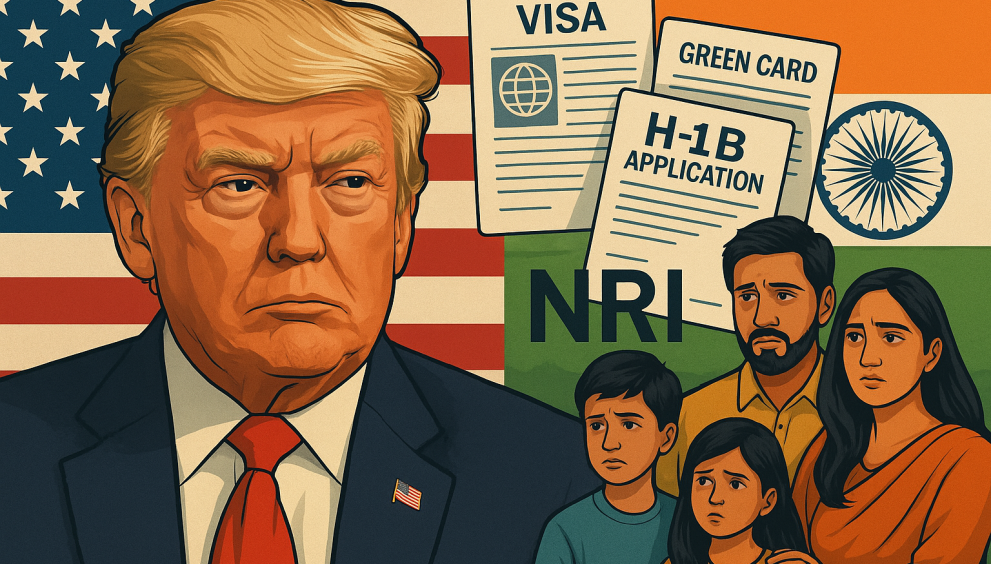
As Donald Trump begins his second term as the 47th President of the United States in 2025, his administration’s policies are expected to profoundly impact Non-Resident Indians (NRIs) living, working, or studying in the U.S. With a renewed emphasis on immigration reform, economic restructuring, and national security, the Trump agenda presents both challenges and opportunities for the 4.5 million-strong Indian American community. This article explores the key policy shifts and what they mean for NRIs.
End of Birthright Citizenship: A Game-Changer for NRI Families
In one of his most controversial moves, President Trump issued an executive order ending automatic birthright citizenship for children born in the U.S. to non-citizen parents, effective February 19, 2025. Previously guaranteed under the 14th Amendment, this policy provided a long-term safety net for families on temporary visas like H-1B or F-1, who often relied on their U.S.-born children for future sponsorship and residency options.
Key Impact:
- Children born to Indian parents on H-1B, H-4, or F-1 visas will no longer gain U.S. citizenship by birth.
- This affects over 1 million Indians currently in green card backlogs, some facing wait times of 54 to 134 years.
- Legal challenges are underway, with lawsuits claiming the move violates constitutional rights.
Bottom Line: NRI families now face increased uncertainty, especially around long-term planning and family immigration pathways.
5% Tax on Remittances: A Financial Strain
As part of the Republican-backed “One Big Beautiful Bill,” Trump’s administration has proposed a 5% tax on all international remittances sent by non-citizens. This measure—designed to help fund permanent tax cuts—applies to all outbound transfers, whether for family support, education, or investments.
Real-World Example:
- A $100,000 transfer to buy property in India will now incur a $5,000 non-refundable tax.
- Monthly remittances for family EMIs or medical expenses will also face the levy.
Unlike India’s refundable TCS on remittances, this tax has no provision for refund or credit, raising costs significantly for NRIs.
Bottom Line: NRIs may shift to fewer, larger transfers or rethink their investment strategies to minimize tax burdens.
H-1B Visa Restrictions and Deportation Policies: Rising Risks
Indian professionals, who account for nearly 75% of all H-1B visa holders, face renewed scrutiny as Trump revives his “Buy American, Hire American” strategy. During his first term, visa denials surged, and similar patterns are expected to return.
Additionally, Trump has pledged mass deportations, targeting undocumented immigrants—including an estimated 725,000 undocumented Indians, many from Gujarat and Punjab.
Concerns:
- Increased denials and delays for H-1B renewals and transitions.
- Deportations have already begun, with reports of harsh detention and transport methods.
- Indian Prime Minister Narendra Modi has expressed concerns to the U.S. administration, citing India’s commitment to legal migration.
Bottom Line: Legal compliance is now more crucial than ever for Indian immigrants, even for those with temporary legal status.
Gold Card Visa: A Gateway for Wealthy NRIs
In a strategic shift, Trump has introduced a proposed “Gold Card” investor visa, aimed at attracting high-net-worth individuals. Priced at around $5 million per applicant, the visa offers a fast-tracked path to citizenship along with “green card privileges plus.”
Benefits:
- Priority residency and naturalization.
- Access to premium tax and investment structures.
- A streamlined process compared to the traditional EB-5 visa.
Bottom Line: This is a golden opportunity for wealthy NRIs to secure permanent residency while contributing to the U.S. economy.
Real Estate Redirection: India Sees a Surge
With uncertainty around U.S. immigration and added costs on remittances, NRIs are increasingly turning to Indian real estate markets for stability and returns. Cities like Hyderabad, Bengaluru, Gurgaon, and Chennai are witnessing a spike in NRI interest.
Market Impact:
- Indian buyers made up 10% of foreign property purchases in the U.S. in 2024.
- That demand may now shift to India, boosting Tier-1 property values.
Bottom Line: NRIs should consider advancing their investment plans in India to avoid future remittance taxes and benefit from favorable market conditions.
U.S.-India Relations: Political Strength vs. Policy Strain
Despite these headwinds, the personal rapport between Trump and Modi remains strong, highlighted by events such as the 2019 “Howdy, Modi!” rally and Trump’s 2020 visit to Gujarat. Surveys show over 80% of Indians continue to view the U.S. favorably.
However, contentious policies like deportations and taxation may test the warmth of people-to-people relations—a cornerstone of U.S.-India diplomacy.
Bottom Line: The political alignment remains intact, but NRIs must prepare for ground realities through practical strategies and active advocacy.
Practical Advice for NRIs
To navigate these transformative changes, NRIs should adopt a proactive approach:
- Monitor Legal Developments: Stay updated on court rulings related to birthright citizenship and remittance taxes.
- Optimize Remittances: Consider making large, one-time transfers before the tax takes effect.
- Ensure Visa Compliance: Keep all immigration documents in order and consult attorneys as needed.
- Explore Wealth Options: High-net-worth individuals should investigate the Gold Card visa and alternative investment routes.
- Engage Community Resources: Tap into Indian American networks, legal aid organizations, and consular support.
Conclusion
Trump’s second term marks a turning point for NRIs in the U.S. While the end of birthright citizenship, higher remittance costs, and tighter H-1B rules pose significant challenges, new avenues like the Gold Card program and real estate investments in India offer paths for adaptation.
The key for NRIs lies in proactive planning, legal preparedness, and financial strategy.
Stay informed. Stay connected. And stay prepared for a new chapter in the NRI journey.